KISHORE KUCHIBHOTLA
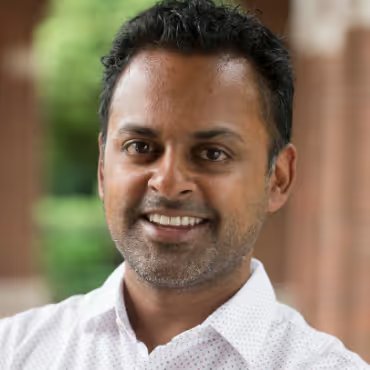


TLDR: I’ve left science twice, missed it twice, and came back twice—taking detours through astrophysics, nuclear security policy, and consulting—before building a neuroscience lab at Johns Hopkins focused on how brains learn, adapt, and sometimes break.
I grew up in Connecticut and landed at the Massachusetts Institute of Technology (MIT), pretty sure I was headed for physics. For a while, that’s what I did: I spent 2.5 years at Harvard’s Center for Astrophysics working with Alyssa Goodman. Then I wandered into a computational neuroscience talk at MIT and was taken aback. The questions felt like physics, but alive: how do complex systems organize themselves, become flexible, become intelligent? How does a brain turn sensation into action, and action into something that looks like thought?
At the same time, I felt pulled in a completely different direction: political science. I couldn’t shake the feeling that if you care about big questions, you should also care about how the world actually works. How do decisions get made? How do institutions behave? And, how might conflict escalate even unintentionally? I made what felt like the first of many “why not everything?” choices: I double majored in Physics and Brain & Cognitive Science and minored in Political Science.
After graduating in 2002, I went to Washington, D.C., and worked at the Stimson Center under Michael Krepon on India–Pakistan nuclear security. We ran Track Two workshops and built simulations about how nuclear accidents could escalate across the subcontinent. It was intense, fascinating work, and felt like serious systems thinking with real stakes.
But I couldn’t shake the feeling that I missed science and would regret not going deep into it. So I went back for a PhD in Biophysics at Harvard with a neuroscience itch I couldn’t ignore. The beginning was… not smooth. I rotated through labs, felt untethered, and came close to leaving again after my first year. Then I found my stride in the labs of Brian Bacskai and Brad Hyman at Massachusetts General Hospital/Harvard, using optical tools to study how Alzheimer’s disease reshapes neurons, astrocytes, and circuits. Brad once told me he wanted to “bring a little bit of Iowa back to Boston,” which was his shorthand for building a lab culture that’s ambitious without being cutthroat. That idea stuck: rigor and kindness aren’t opposites. I’ve been trying to live up to it ever since.
I stayed until I graduated in 2009, but then got the D.C. bug (again!) and left academia (I was pretty sure it was “for good,” which is a phrase I now use with caution). I joined McKinsey & Company in its public sector practice. I learned a ton about how organizations behave, how incentives quietly run the show, and how to communicate clearly when the room is skeptical and the clock is unforgiving.
Still, the brain kept tugging. Like a song you can’t stop humming, the questions didn’t go away; they just were sitting there waiting to be reactivated. I also had a realization in DC: no domain is immune to status games. I wasn’t yearning to come back to science, thinking that it was above it all. I realized instead that impact is often temporary, and prestige cycles faster than you’d think. In the end, every job makes you pay the piper. In science, that means being smart about grants, papers, talks, and all the usual rituals. I realized that the exciting part (for me) is that if you can do that, it earns you the privilege of disappearing into a little experimental sandbox to try to learn something new. Occasionally, it even works.
So in 2012, I came back to science again, changed fields, and joined Rob Froemke’s lab at NYU to work on circuits and behavior. I went all in. Those years reconnected me to what got me hooked in the first place: trying to understand how cells and circuits beget behavior… and, if we’re allowed one more reach, maybe even the mind.
Since 2018, I’ve been building my lab at Johns Hopkins University, and the lab’s interests have continued to evolve toward circuits, dynamics, learning, and cognition. I’m drawn to what I think of as disciplined wandering: staying anchored in some core ideas while letting people in the lab and interesting results pull us into adjacent, and often underexplored, territory. We work on cue-driven learning, continual learning, habit formation, auditory coding, Alzheimer’s disease (in mice and humans), human learning, and even echolocating bats. Our projects are partly a mirror of the people who join: what they bring, what they’re curious about, what they’re excited to try. It’s controlled chaos, but there’s a method to the madness (I hope).
I also don’t romanticize academia. There are headwinds: funding, publishing, politics, and frustration. But my time outside the university was clarifying. Every world has problems, but this one has discovery and community, which together make the annoying parts worth doing.
Work isn’t everything, though. I’m happiest with my wife and our two kids. I miss having real time for tennis and basketball (I’m betting that comes back as the kids get older). We love traveling, trying new restaurants, and spending time with friends and family. We regularly make our way back to France to see my in-laws.
Having stepped outside academia and returned (twice), I’ve gotten better at seeing this job clearly. It’s imperfect and demanding, but it still offers something rare: long stretches of time to learn something new about the world, alongside people who share the same joy in figuring things out.


